
Texas is Open for Business: A Pacific Northwesterner’s Solar Report from Oil Country
I recently attended the regional InterSolar conference in Dallas, Texas, where I learned a lot and saw some impressive new equipment we may begin to offer. I also felt a bit like a solar industry tourist since so many of the seminars were specific to Texas policy and laws. My 25 years of solar conference experiences typically include discussions of environmental aspects of solar, climate change, and carbon mitigation, and while Texas is the fastest growing solar state in the country in terms of deployment, this event really had no talk of those issues. The overall message of the conference was that Texas is open for business and will use their abundance of solar, wind, and of course gas and oil to pursue the development of all forms of energy as rapidly as possible, to generate the largest amount of inexpensive reliable electricity as possible. In this way the state would be the most competitive and attractive location for all the new businesses they could possibly get. Overall, data centers were a major focus of the event. Texas has recently seen huge investments from Oracle, Meta, SoftBank, and OpenAI.
A couple of recent victories that were touted during the show to validate the success of that strategy. Toyota announced last year a $530 million expansion and 400 new jobs at an existing facility in San Antonio. Apparently a 20 year commitment to a low electricity rate schedule was a major factor in winning this expansion when Toyota was considering various sites in the US, Mexico, and Canada.

PSE Flex Battery Program Expansion for 2026
PSE has announced that they have added the Franklin and Enphase ESS (Energy Storage Systems, or more simply, batteries) to their Flex Program for storage. Customers with previously installed systems will be able to enroll some time shortly after the beginning of the year. PSE has revamped the program to pay a one-time rebate of $75/kWh of storage ($1000 maximum), and $0.50 per kwh ($500/year maximum) during utility-activated Flex Events.
PSE’s Flex Program
Puget Sound Energy (PSE) is the state’s largest utility and has been showing some innovative thinking in terms of transparency and involving customers in demand response. Demand response is a term that describes altering energy usage to match availability. As we phase out polluting fossil fuels, we will increase electrification and install more renewable energy sources on the grid. Those renewable energy projects will be both utility scale and smaller distributed generation like the solar arrays on our clients’ roofs. There are benefits to everyone that participates in this transition, and there will be some new challenges as well.
PSE is taking advantage of current technology to communicate with their customers to give them the option to participate in several different ways. In the simplest form, PSE texts customers and lets them know there is an incentive to decrease your power consumption at the moment. Customers get paid to enroll in the program and get paid for the savings they can enact during what PSE calls “Flex Events.” Additional aspects of the program can provide rebates and incentives for using “smart” thermostats, EV’s, or residential-scale batteries which can be controlled by the utility to shift the timing of demand or to allow PSE to utilize stored energy. Learn more from PSE here https://www.pse.com/en/rebates/PSE-flex
If you are a PSE customer, there is no downside to enrolling in the alerts, so I would certainly say to go ahead with that at least. You can learn more for yourself about the details of the other aspects of the program.
Reasons for the Flex Program
PSE has said they don’t implement the Flex protocols in advance of outages necessarily, but that it is more of a cost savings measure at times when energy is more expensive. Kiara Doyle gives some coverage to PSE’s program for the Seattle Medium here https://seattlemedium.com/reduce-energy-costs-seattle/
One of the main underlying trends our region is facing is a decline in available hydro power due to declining precipitation and snowpacks. There is no doubt we are seeing the climate gradually changing, even if there is still discussion regarding the complexity surrounding the causes of global climate change and the effects we see here in the Pacific NW. The main reason we have been motivated to create Power Trip Energy and to continue encouraging clean local rooftop solar is to mitigate our contribution to CO2 into the atmosphere, while helping our clients save money. Even if one does not think there is conclusive evidence showing correlation between human carbon emissions and decreased snowpack feeding our hydro system, it seems that it makes a lot of sense to err on the side of caution and avoid them as much as possible.
Another dominating trend we will see is a continued transition to clean renewable energy. In 2024, over 80% of the new power capacity on the US grid was solar and batteries. We are seeing a significant increase in the power we need for electrification of homes and vehicles, and for new energy hungry industries such as the increase in data centers for our information technologies.
You will be participating in this change whether you take personal action or not. The question will be whether you pay someone else to provide your power, or whether you invest in producing it yourself. You can help the grid by providing power during peak loads, and get a little help with your electric bill at the same time. During an outage, you could have a measure of emergency back-up with these batteries. If this resonates with you, we’d be happy to talk to you about how you can effectively and economically make solar power on your own roof that helps you every day, and store it in batteries that can help you have power during an outage, and help PSE during peak loads.


“Drill Baby Drill”
This week marked a change in direction of our federal government’s energy policy. While previous administrations have supported renewable energy goals and honored our commitments to the international community regarding climate goals, the incoming administration will be working to reverse those efforts.
The new president stated that he was taking action to withdraw from the Paris Agreement on Climate (again) stating “I will also declare a national energy emergency. We will drill, baby, drill. America will be a manufacturing nation once again, and we have something that no other manufacturing nation will ever have: the largest amount of oil and gas of any country on Earth. And we are going to use it. We will bring prices down, fill our strategic reserves up again, right to the top, and export American energy all over the world. We will be a rich nation again. And it is that liquid gold under our feet that will help to do it.”
For our part we do not agree with this proposed national energy policy. We do not agree that this is a reasonable path to wealth for anyone other than oil companies and gas utilities, nor is it sustainable for the environment.
We have spent over two decades installing solar in order to make the cleanest electricity possible at the point of use, to the benefit of our clients that own the solar arrays on their roofs. Over 1200 of our clients have installed rooftop solar arrays on the Olympic and Kitsap Peninsulas, and electric vehicle charging equipment, and have electrified where they can in order to save money and replace the burning of polluting fossil fuels.
If your goals for a personal energy policy involve making clean energy and saving money on your bills, please email or call to learn more about how solar could work at your home.
PSE Flex Program Enrollment
PSE’s Flex Program
Puget Sound Energy (PSE) is the state’s largest utility and has been showing some innovative thinking in terms of transparency and involving customers in demand response. Demand response is a term that describes altering energy usage to match availability. As we phase out polluting fossil fuels, we will increase electrification and install more renewable energy sources on the grid. Those renewable energy projects will be both utility scale and smaller distributed generation like the solar arrays on our clients’ roofs. There are benefits to everyone that participates in this transition, and there will be some new challenges as well.
PSE is taking advantage of current technology to communicate with their customers to give them the option to participate in several different ways. In the simplest form, PSE texts customers and lets them know there is an incentive to decrease your power consumption at the moment. Customers get paid to enroll in the program and get paid for the savings they can enact during what PSE calls “Flex Events.” Additional aspects of the program can provide rebates and incentives for using “smart” thermostats, EV’s, or even batteries which can be controlled by the utility to shift the timing of demand or to allow PSE to utilize stored energy. Learn more from PSE here https://www.pse.com/en/rebates/PSE-flex
If you are a PSE customer, there is no downside to enrolling in the alerts, so I would certainly say to go ahead with that at least. You can learn more for yourself about the details of the other aspects of the program.
Reasons for the Flex Program
PSE has said they don’t implement the Flex protocols in advance of outages necessarily, but that it is more of a cost savings measure at times when energy is more expensive. Daniel Schrager just had a nice article in The Olympian here (paywall, 24 hour free access for registering) https://www.theolympian.com/news/state/washington/article298205253.html
One of the main underlying trends our region is facing is a decline in available hydro power due to declining precipitation and snow packs. There is no doubt we are seeing the climate gradually changing, even if there is still discussion regarding the complexity surrounding the causes of global climate change and the effects we see here in the Pacific NW. The main reason we have been motivated to create Power Trip Energy and to continue encouraging clean local rooftop solar is to mitigate our contribution to CO2 into the atmosphere, while helping our clients save money. Even if one does not think there is conclusive evidence showing correlation between human carbon emissions and decreased snowpack feeding our hydro system, it seems that it makes a lot of sense to err on the side of caution and avoid them as much as possible.
Another dominating trend we will see is a transition to clean renewable energy to provide the additional power we need for electrification of homes and vehicles, and for new energy hungry industries such as the increase in data centers for our information technologies. You will be participating in this change whether you take personal action or not. The question will be whether you pay for someone else to provide that new power, or whether you invest in producing it yourself. If this resonates with you, we’d be happy to talk to you about how you can effectively and economically make solar power on your own roof.
Biden Administration’s Energy Policy Successes
The last four years has seen a continued increase in the adoption of renewable energy, and many state’s have made Net Zero commitments by certain years. The main change we have seen is that there is a domestic manufacturing renaissance in clean energy and storage underway due to the provisions in the IRA and the CHIPS and Science Act, both passed in 2022. There have been many announcements of new solar and battery manufacturing facilities in the US. We shall see if the incoming administration disrupts those programs, however if the goal is to stop conceding high tech and manufacturing jobs to the Asian economies, there is some healthy momentum at present. The US added about 150,000 clean energy jobs in 2023 according to the 2024 report here https://www.energy.gov/policy/us-energy-employment-jobs-report-useer.
Secretary of Energy Jenifer Granholm is interviewed by Robinson Meyer of the Shift Key podcast, and we found it to be an educational hour. https://heatmap.news/podcast/shift-key-s2-e18-jennifer-granholm
We are hopeful the incoming administration continues the current positive trend, however it has been announced the nominee to head this department will be Chris Wright, who is the chief executive of an oil and fracking services company. While it seems likely that we may be taking a step backwards at the federal level, much of the progress that has been made is not able to be undone at this point. Again we may find ourselves in a situation where some states will lead and ultimately the progress will depend on us as individuals. This is a situation we have become accustomed to over the decades and is at the heart of our mission here at Power Trip Energy.
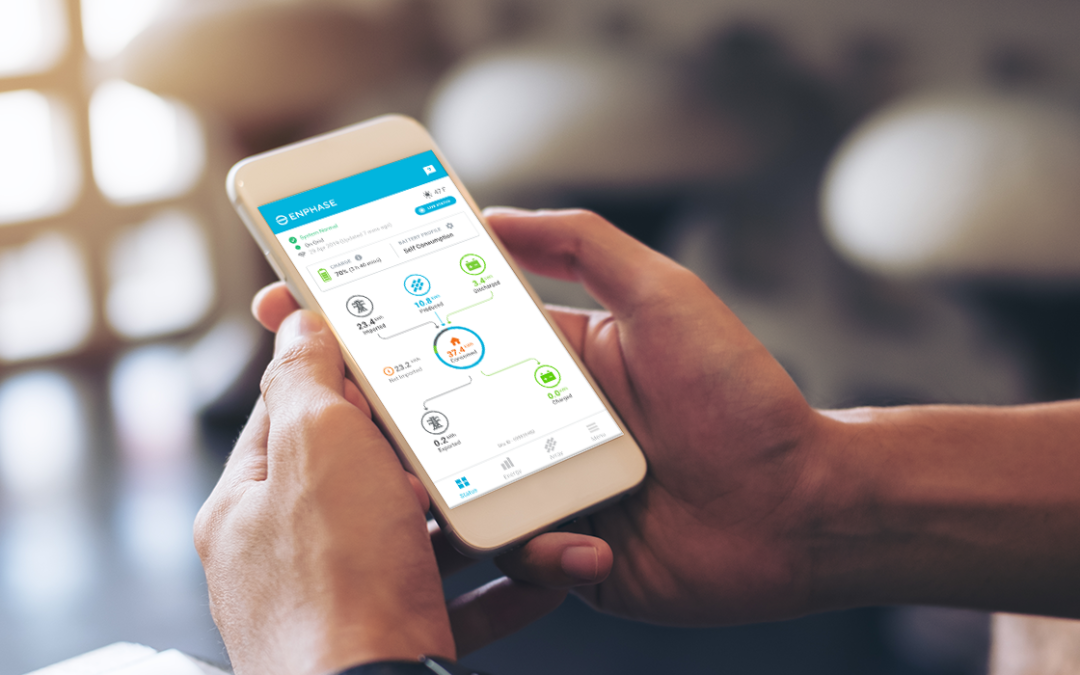
Enphase App Tutorial on their YouTube Channel
We were pointing a new client to some resources to help them get familiar with their new Enphase PV system, and especially a brief tutorial for the data monitoring app on their phone. We sent them a link to this video below. I want to take a moment to compliment Enphase on their clear communication and their prolific and well-organized YouTube channel. https://www.youtube.com/@EnphaseEnergy
We have about 700 Enphase systems in the field, mostly with their microinverters incorporated in Sunpower AC modules, and now more and more as a stand-alone microinverter under a couple of different module brands.
Transition to Electric Vehicles Linked to Lower Pollution and Fewer Asthma-Related ER Visits
Now that we have been on the path of increasing use of electricity for personal transportation, researchers are beginning to be able to statistically link the benefits of EVs to reduced pollution and illness by zip code, and correlate with higher EV adoption rates.
This study looked at EV adoption by zip code in California (the state with the fastest EV adoption rate, providing the largest amount of relevant data) and showed that the zip codes with higher EV registration rates had measurably lower NOx pollution and lower Asthma-related ER visits as EV registrations increased.
This may feel like an obvious correlation to some of us, but it is useful to begin building the scientific body of work to support these claims. The immediate human benefits of the transition to clean energy may sometimes be understated if there is a lack of hard data.
https://www.sciencedirect.com/science/article/abs/pii/S0048969723003765
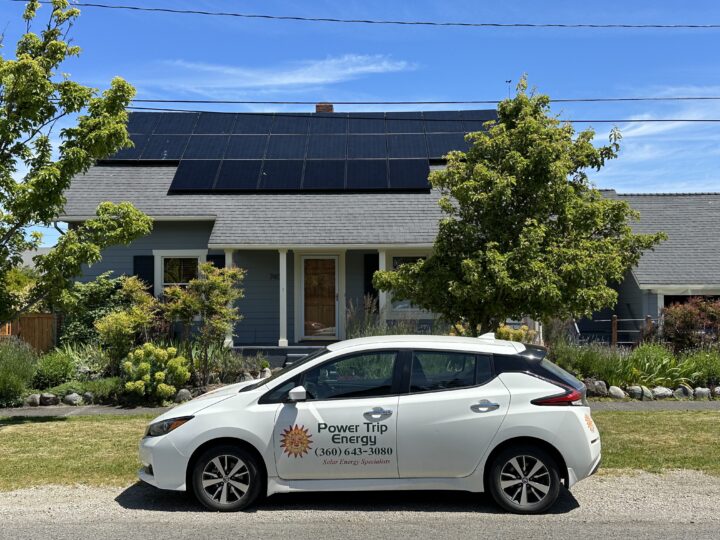
Power Trip Energy 9 KW SunPower Array, Port Townsend, May 2024
US Oil Production at Highest Level in History
US Oil Production at Highest Level in History
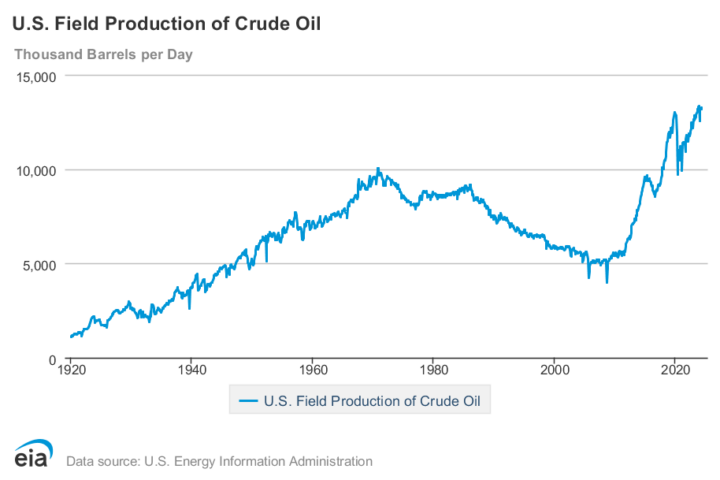
We are taking a short break from our usual locally-themed news and observations because it is worth noting that US oil production has set another record. Despite increasing support for renewable energy, and in seeming contrast to a steady stream of good news about increased renewable energy production, we are faced with the reality that oil production in the US is at the highest rate in history. While we have seen a couple of drops in production in the last 20 years, the truth is that US oil production has been on a steady steep increase since the Obama administration.
There are a couple factors that might make this surprising to some. As a whole, most Americans acknowledge the role of CO2 in climate change and recognize that we should be working to decrease our contribution to this issue. It may also surprise some since it is politically popular for some candidates to claim their opponents are trying to kill the oil industry – evidence suggests otherwise. All federal administrations have recently presided over significant oil production increases.
The issue is complicated by the fact that while the US is now the largest oil producer in the world, most of our oil is exported. It is popular to complain about the price of gas, and it would seem contrary to the basic rules of economics that prices would rise as supply increases, however we see that demand for oil is growing at a much faster rate than the supply. Some might suggest it is foolish to race to utilize and export this finite resource due to the pollution it creates when burned, and its utility as a resource to our country in the long run. Apparently the people in a position to profit from this policy right now are successful implementing their plans into action. Let us know what you think the graph below indicates about US energy policy.
These are large complex global issues, beyond the ability of your local solar company to understand or to have an effect. The evidence that the underlying problems with our energy industry continue to worsen provides motivation for us to continue to help our clients craft their own personal energy policy. For over 22 years we have been spreading the news that you can put solar on your roof, replace your gas furnace with an electric heating unit most likely a heat pump, improve your insulation, and get a bike and an electric vehicle so you don’t need to buy gasoline. For an average homeowner on the Olympic Peninsula, it is possible to provide all of your own energy for your home and your transportation with roof top solar, while increasing the value of your home, and stopping your support for the domestic and global oil industry and its associated avarice and pollution.
If you are looking to craft your personal energy policy, now would be a good time for you to speak to us and put your own plans into action.


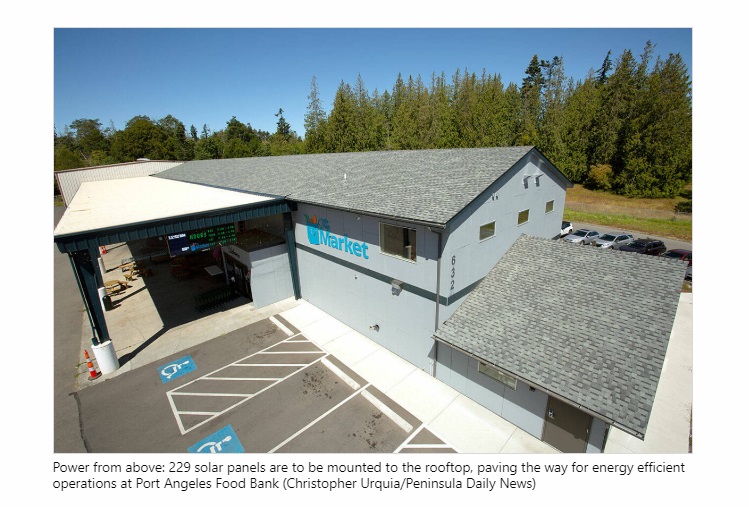
Port Angeles Food Bank Plans on Going Solar for the Community
Kirk Haffner – South Sound Solar
We just lost a pretty special brother in the WA Solar industry. Kirk was smart and industrious, and the times I spoke with him he was always consistent in his beliefs and efforts. He ran a very good company, and in spite of the challenges faced by everyone running a small contracting business, the thing that stands out was Kirk’s generousity with his time and perspective. He was very collaborative (this is actually characteristic of many of the businesses that have been installing solar for a long time in this state.) Condolences to family, friends, and employees. We will miss Kirk greatly and we are very glad he was able to take the steps so South Sound Solar would continue, may it live long and prosper!
There is a brief write up here: https://www.facebook.com/share/p/HPPHDYC2yxZDC6Pd/
