California’s Solar Mandate Firms Up for 2020
Since 1978, the California Energy Commission (CEC) has enforced T24 standards. The 2016-2019 code cycle required all new homes to be highly energy-efficient and be “solar ready”. These initial standards required builders to make a rooftop area available for solar and include a space for a circuit breaker to connect any future solar inverter. In the 2019 code, which takes effect in 2020, California now goes further.
To help achieve California’s ambitious climate goals, the state has just become the first in the nation to require all new homes to include solar panels starting in 2020. With the new Title 24 changes, builders are now required to include a minimum solar PV system to offset the expected electrical load of the home.
While a part me rejoices at this advancement, I am also wary of mandates, that is not usually how I like things to be done. However, there are many building code issues that we all live with whenever we choose to build a new home, either as homeowner or builder. Relative to some other requirements, mandatory solar seems completely reasonable. California leads the way again – hopefully Washington and Oregon will soon follow this progress. I would completely support such a mandate, with clear exceptions if people are unfortunate enough to be building a home in the shade.
Andy Cochrane, Sept 16, 2019
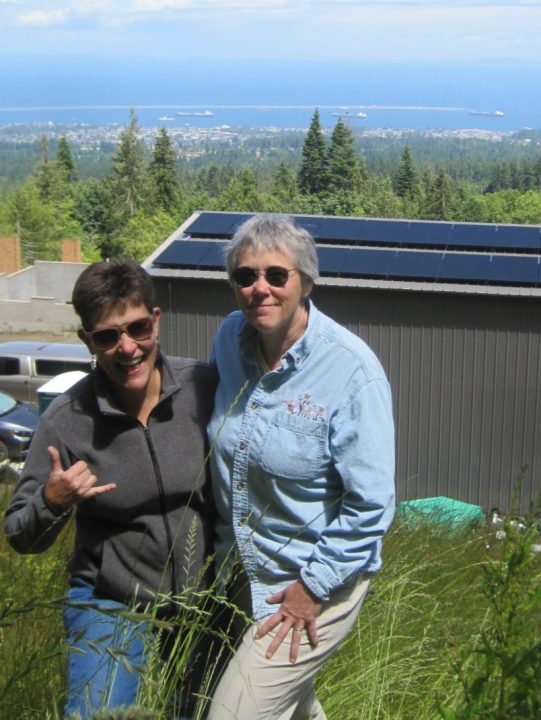
7.7 KW SunPower Array – Port Angeles, WA – Clallam PUD Grid – May 2019
Buyer Beware – Fly By Night Solar, Inc
We have recently had a conversation with someone adversely affected by an unreliable contractor. I have been hearing sad tales like this during the entire 16 years we have been in business – these stories seem to come in waves. Most of these unfortunate events could be avoided by doing a little research and talking to existing happy customers and looking at a company’s track record. Unreliable companies rarely make it two years. While the fact that a company is new should not prevent you from working with them, you should be much more careful with a new company.
I will be forever grateful to Mr Lee Doughty who wrote me a large check in December of 2002, when this solar company was just a gleam in my eye. The trust he placed in me will always be appreciated and cherished. I would hate to think that my lack of other existing customers at the time would have prevented him from working with us – how is a small company supposed to get their first customer otherwise?
Support for earnest young start-ups aside, please do your research when hiring a solar contractor. This goes for any trade, but something about solar seems to attract companies that take advantage of a customer’s good intentions and enthusiasm with some gee-whiz marketing.
Here are some Yelp reviews that collectively tell a distressing story. https://www.yelp.com/biz/offset-solar-liberty-lake Of note, we don’t pay Yelp for our listing, I’m not sure if reviews can be left if we don’t pay for their service, however for existing customers read this and use Yelp (you need an account to provide review) are so motivated, we would appreciate a Yelp review or two or three.
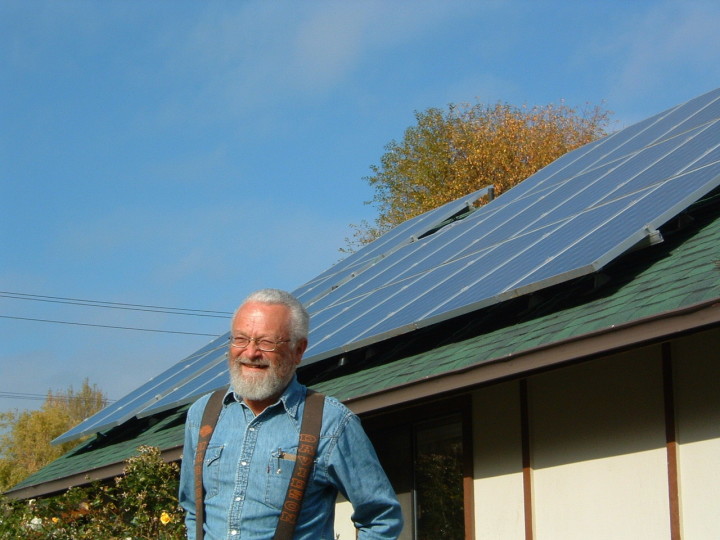
In 2002 Lee was a Solar Pioneer! In 2006, he enlarged his array and had the biggest one in town for a while.
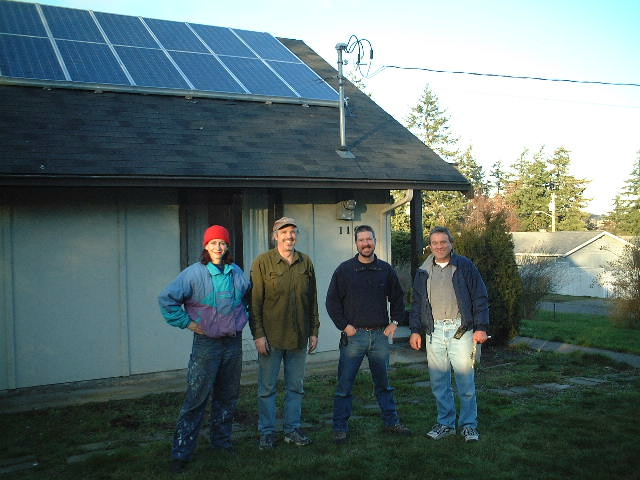
Prior to becoming electrical contractors in 2004, we worked with Puget Sound Solar to install our projects. Ara, Jeremy, Andy, and Emil at Jefferson County’s first Grid-tied PV installation, February 2003.
A Fully Renewable Energy Grid in US is Attainable in 10 Years
Wood MacKenzie recently published a study outlining the specific steps that would need to be taken in the next 10 years in order to accomplish a fully renewable energy grid here in the United States. Their article can be accessed here https://www.woodmac.com/news/feature/deep-decarbonisation-the-multi-trillion-dollar-question
The price tag of this ambitious endeavor including grid-level storage and eliminating nuclear plants is $4.5 trillion. This figure is not unattainable, there are several ways to put that into perspective. It is roughly equal to the annual federal budget. It is roughly equal to what we have spent on the “War on Terror” since 2001. It is $165 per household per month over the next 10 years.
Currently about 30% of our domestic energy use is through the electrical grid. The job of going 100% renewable on the electric grid is also made more challenging if we can rapidly shift the 30% of the energy we use for transportation away from nearly all petroleum to nearly all electricity. To maintain perspective, we find it helpful to review the Lawrence Livermore Labs energy charts, recently updated for 2018, see below.
The economic benefits of such an investment would be tremendous. As with solar on rooftops, once the investment is made, the ongoing cost of energy is very, very low (some people say “free”, I don’t agree.) The real world benefits of such a move would be to remove out electricity sector’s contribution to pollution both in terms of carbon, and the smog from nitrogen oxides, and sulfur, mercury and other poisonous emissions from fossil fuel consumption. There is no doubt in my mind that this is a goal we must pursue as quickly as possible, for many reasons.
Of note, Washington’s Gov Jay Inslee shares our perspective and has a very high energy literacy. He has a detailed and credible plan to implement much of what the Woods Mackenzie report outlines, while also analyzing the job creation benefits at the same time. It is worthwhile to take a close look at Gov Inslee’s vision here https://jayinslee.com/issues/evergreen-economy
While these national policy goals are important to consider, we prefer to spend our days installing solar on rooftops here on the Olympic Peninsula. It is something that we can feel good about every day, knowing we are helping our clients save money, decrease their contribution to pollution, and take steps towards a cleaner future.

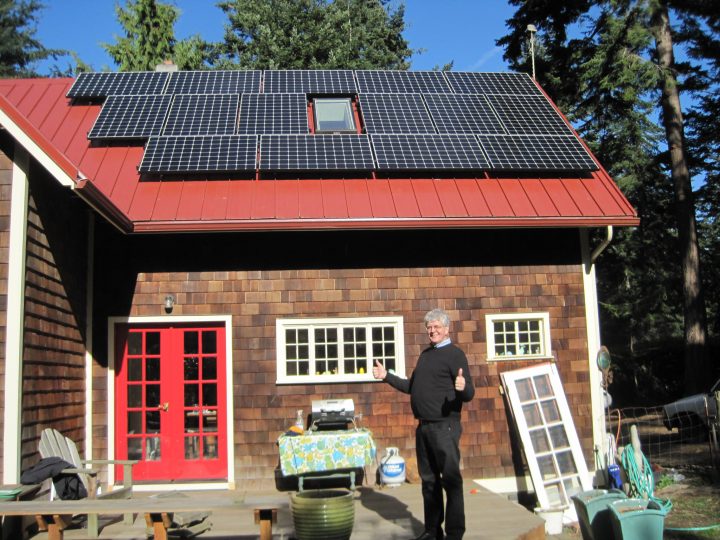
John Hanson, Port Townsend, 2014 – https://www.ptleader.com/stories/john-caesar-hansen,62338?
Electric Transportation and Micro-Grids Making Progress
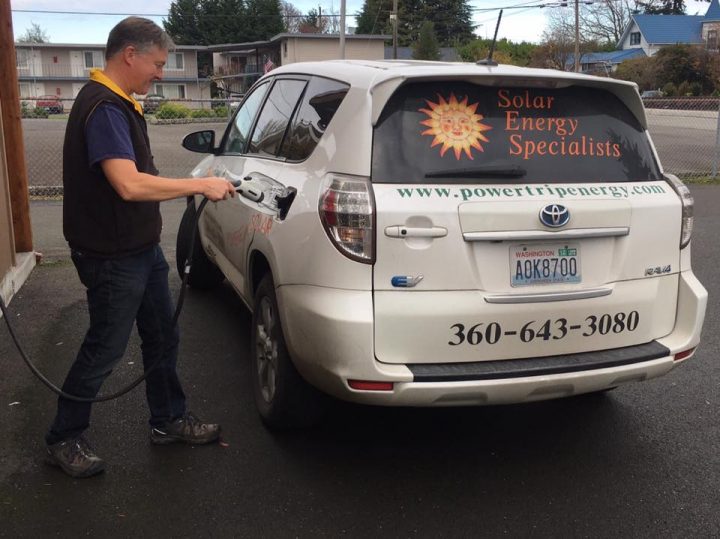
In the US, 30% of our carbon emissions derive from transportation. The improvements in cost and performance of electric vehicle represent a great immediate opportunity for us to decrease our carbon pollution. EV sales in 2018 increased 81% over the previous year.
Here in the Pacific Northwest, we have an abundance of renewable energy resources and at the macro level, namely the existing hydro system and the significant wind farms installed in the last 15 years. We also have an abundance of sunshine providing great opportunity for distributed generation. When you utilize solar pv to replace your gasoline consumption, you are reaping a tremendous financial gain and also making a significant decrease in your personal carbon pollution.
While these micro-grids are new and not inexpensive, we have begun to perform installations around the edge of this technology. This article talks about the benefits fleet managers at larger corporations are seeing in markets where the electricity cost signals and reliability issues are a little different than our location, however this is probably coming universally. Who will be the first locally to see the benefit of EV fleets and on-site solar generation using a micro-grid?
https://www.greentechmedia.com/articles/read/why-electrified-transportation-needs-microgrids
Solar Fairness Act (SB 5223) signed by Governor, Net Metering Expanded
This year was a successful year for solar advocates in the culmination of a multi-year effort to expand and protect Net Metering. Washington’s Net Metering law now requires utilities to accept grid-tied net metered solar pv systems up to 4% of the 1996 peak load, which means there is an 8-fold increase relative to the former 0.5% threshold.
Every utility in which we operate had exceeded this threshold so now everyone has certainty as to what the utilities must do now. This law preserves the rights of individuals to invest in their own solar equipment, and receive fair compensation for the electricity they provide to the utility. Even though all utilities in whose territory we operate but one had continued to provide retail net metering even above the state required threshold, we now have certainty and stability.
Also of note, the annual true up date has been changed from April 30 to March 31, which should protect several of our customers that begin to generate monthly credits as early as April. As it becomes more common for our clients to produce 100% of their own energy over the course of the year, that is a small change which will be helpful.
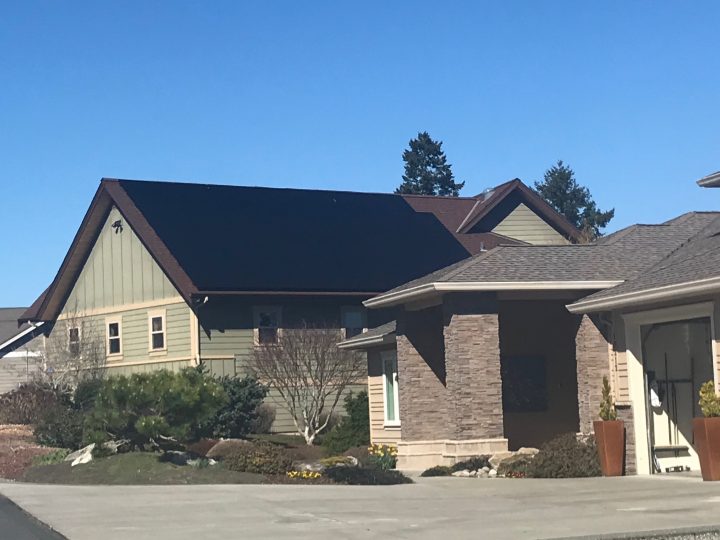
14 KW SunPower on a Keyport Residence, March 2019
Clallam PUD Offers 30 KW of Community Solar – Get It While It’s Hot
If you are a customer of Clallam PUD, and want to buy some solar electricity, but can’t install solar on your own house, you should look into their newly announced Community Solar project. You should probably sign up sooner rather than later because I anticipate this project will be fully subscribed very quickly. This project will be a 30 KW ground-mounted installation in downtown Sequim.
The PUD is offering shares equivalent to 15 watts of solar capacity each for about $60. Individal PUD customers can buy up to 125 shares. The project has a guaranteed 25 year life. The project will be installed by the end of the year, the details as to the equipment or any installation contractor have not been determined. The details are on their website here: https://www.clallampud.net/communitysolar/
At $4 per watt, the shares are roughly equivalent to the price for our roof mounted pv projects, so if you own a home and could afford to do at least a 5 KW system, you should consider installing on your own house rather than participating in this program. However the Community Solar project is ideal if you can not put solar on your own home, or if you have already filled your own roof with solar panels and are not yet making 100% of your own clean energy.
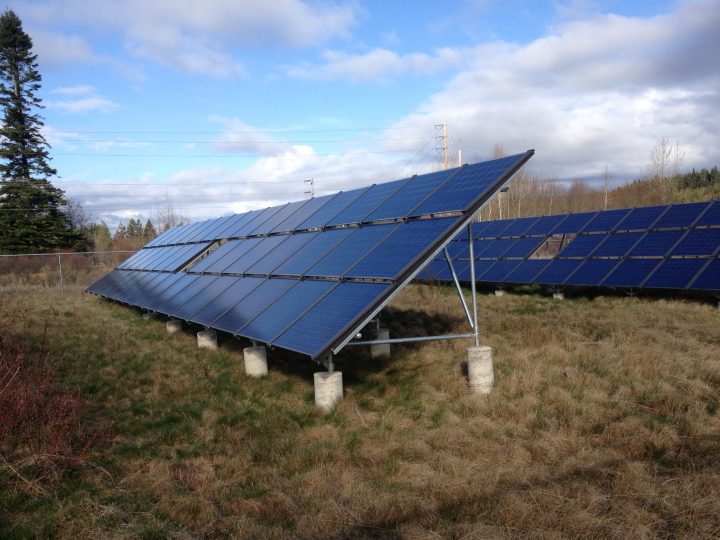
17 KW Community Solar Array, Jefferson Intl Airport, Port Townsend, 2011
SunPower Offers $1000 Gift to Sierra Club and $1000 Rebate for Homeowners
SunPower has been our favorite PV manufacturer for years. They offer the highest efficiency, highest quality, leading technology, cleanest manufacturing process, and the best warranty in the industry. Now they are offering a $1000 donation to the Sierra Club and a $1000 rebate for Homeowners on new projects.
At Power Trip Energy, we will handle the design and installation of your project, and we handle all of the paperwork for your net metering interconnection with the utility, and this rebate program. Ask us for details when you schedule your site evaluation.
While the federal government debates the Green New Deal, and our state considers a 100% Renewable Energy Portfolio Standard, you can take action now in your own home to make your own clean electricity. When people lead, the leaders follow.
14 KW SunPower AC Modules, Keyport, WA, March 2019
Solar Fairness Act (SB 5223) passes Senate
It is important to update our state’s Net Metering law, originally passed in 1998, to reflect the current state of the market and protect homeowners’ investments in their home. The new bill would raise the cap from 0.5% to 4% and provide a path for continued investment. SB is sponsored by Sen Palumbo, and recently passed the Senate, now for consideration by the house.
We sent a letter to Sen. Van de Wege thanking him for his vote.
Subject: Thank you for supporting the Solar Fairness Act (Senate Bill 5223)
Body:
Dear Sen Van de Wege,
I appreciate your yes vote on the Solar Fairness Act to pass it out of the Senate last week.
As you know, our clients are counting on the state’s protection for the fair value of their solar electricity. That protection and guarantee of reliable fair compensation from utilities give us the ability to give the needed peace of mind to our clients while they are considering this investment in clean energy for their home and our community.
Please consider me your resource whenever I can be of any assistance to your office in matters relating to solar energy.
Best regards,
Andy Cochrane
An Array of Energy Bills in Olympia this Short Session
This year in Olympia is a “short session” for our part-time legislature. Solar Washington has published a summary of the various energy-related bills, several of which have the potential to make significant progressive steps for our state. I encourage you to take a look and see which of these bills might excite you to contact your representatives. https://www.solarwa.org/washington_solar_legislation
SSB (Senate Substitute Bill) 5223 is the bill that affects homeowners considering grid-tied solar PV systems most directly by increasing the threshold of the net metered capacity required of utilities from 0.5% to 4% of the 1996 peak load. We have exceeded the current threshold in every utility district on the Olympic Peninsula, and we have seen one regressive utility mired in some backsliding that has a negative impact on our clients. This bill would incur no costs to the state or utilities and would remove the potential for impediments which discourage individuals from investing in clean energy for their homes and communities.
I encourage you to read and support this improvement to our state’s net metering, which will bring our thresholds into the 21st century.
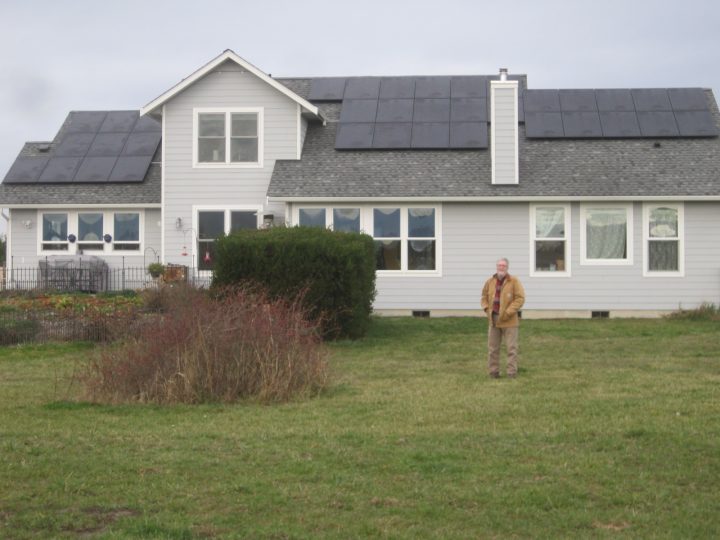
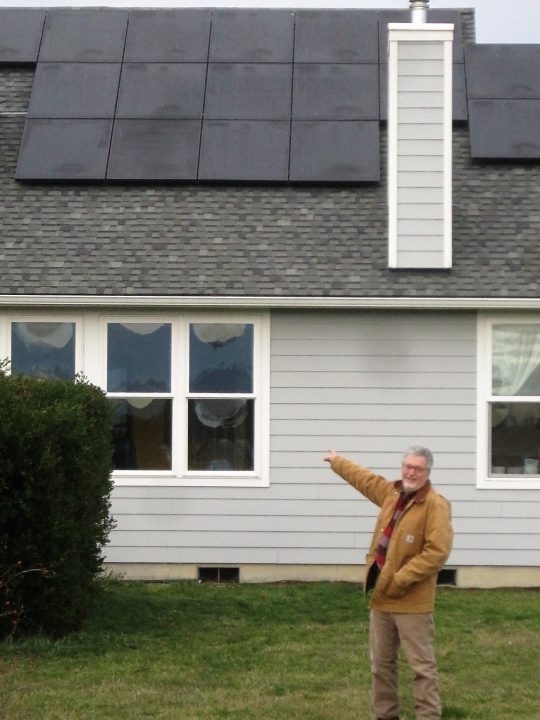
11.7 KW SunPower array – Sequim – December 2018
Clean Yard Work – A Special Offer of New Tools
Get a free Dewalt lithium yard tool of your choice or EV charging equipment when you order a solar array in the month of February.
If you are like me, you love being in your yard. Most of our clients spend a fair amount of time and energy to create beauty, perhaps grow some tasty food, and generally work to make their yards into nice outdoor spaces in which to spend time. At my place, it takes a whole lot of work to maintain that space, which I mostly enjoy, but it involves the use of some tools I don’t love. When you are outdoors you may hear a neighbor running a gasoline mower, a weed whacking string trimmer, or perhaps a landscape service running a leaf blower or hedge trimmer.
Even the use of a relatively clean four stroke engine results in the burning of gasoline and the resulting noise and pollution. At my home, I recently added a couple of lithium battery-powered electric yard tools. Some of the ones I looked at a couple of years ago seemed expensive and underpowered, but this year, one tool in particular changed my mind and has set me on the path of electric mowing and trimming.
A friend bought a DeWalt electric lithium chainsaw. I laughed to myself at first, but my mind quickly changed when he dropped a couple of trees in his woodlot. It seemed every bit as powerful as my Stihl two stroke chainsaw. True, the battery only lasted enough to cut a couple of trees, so it will not be replacing gas-powered chainsaws for professional lumberjacks anytime soon, but it seems fine for a homeowner that may use a chainsaw for maintenance and clean up or cutting a couple of trees at a time.
That motivated me to try out the new lithium electric DeWalt string trimmer and I was very impressed. I can run it for over an hour on a single charge, and that is plenty of time weed whacking at once for me at my place. Shortly after that we got a Ryobi mower and a DeWalt hedge trimmer for heavier brush cutting. These tools all work very well and fulfill my goals of keeping my yard maintained while not burning gas.
In the past, we have run specials wherein we include the installation of Electric Vehicle charging equipment at no cost with a new solar array. Getting an electric vehicle is probably the biggest change you can make concurrent with installing solar to decrease your carbon emissions. This summer, we are now going to run a special to encourage you to switch to a cleaner way of maintaining your yard.
When you order a solar pv array 4 KW or larger in the month of July, we will throw in your choice of DeWalt electric lithium mower, or a package including one DeWalt string trimmer and one hedge cutter.
If you order a larger system of 12 KW or more in the month of July, we will give the choice of either all three of those yard tools, or a Clipper Creek LCS-25 Electric Vehicle charging station (including installation.)
This offer expires July 31st.
Of course our main goal is to install solar on your home, but we also want to do everything we can to make sure we use that clean power for all we can. While there are complications and disagreements regarding the science and politics of climate change, in general we feel there are indisputable benefits to this goal:
Electrify everything, and make sure that electricity is carbon free.
To learn more, please give us a call or come on one of our upcoming solar home tours.

A – DeWalt lithium cordless 13” String Trimmer and 22” Hedge Trimmer Package (# DCST920B820P1)

B – DeWalt lithium cordless mower (# DCMW220P2)
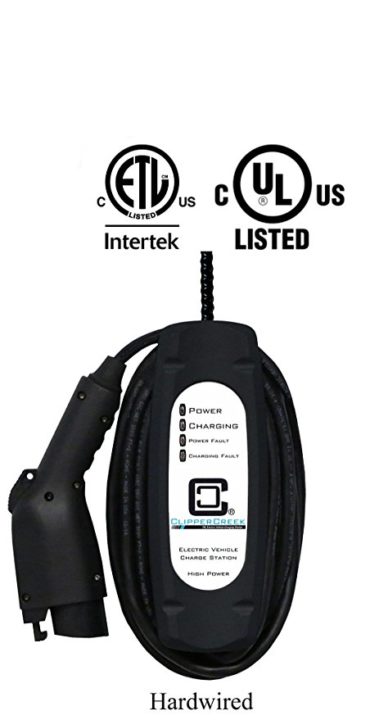
C – Clipper Creek LCS-25 Level II EV Charging Station