
PSE Flex Program: Battery, Thermostat and EV Rewards (2026 Guide)
PSE Flex is Puget Sound Energy’s demand response program: PSE pays its electric customers to use less power, or to let an enrolled battery, thermostat, EV charger or water heater ease off, during short periods of peak demand called Flex events. The biggest payment is for home batteries: $75 per kWh of storage on enrolment, up to $1,000 per battery, plus $0.50 per kWh during events, up to $500 per battery a year. This guide covers every part of the program as PSE lists it today, and what it means if you are adding a battery to your solar.
Figures checked on pse.com on October 20, 2026. PSE can change the program, so confirm on PSE’s Flex page before you rely on a number.
Request a free solar evaluation
The five ways to join PSE Flex
Each part of the program pays differently. You can combine Flex Batteries with Flex Smart and Flex EV, but not with Flex Rewards.
- Flex Batteries: your battery discharges automatically. $75 per kWh of storage on enrolment, up to $1,000 per battery, then $0.50 per kWh during events, up to $500 per battery a year.
- Flex Rewards: PSE texts or emails you and you cut your use. $25 on enrolment, $1 per kWh saved and $15 a year.
- Flex Smart: PSE nudges your smart thermostat a few degrees. Up to $50 per device on enrolment and up to $40 per device a year.
- Flex EV: your home EV charging waits until the event ends. $50 on enrolment and $0.50 per kWh saved.
- Flex Water Heaters: your electric water heater adjusts. $20 on enrolment and $20 a year.
Source: PSE Flex, October 2026. Flex Rewards, Smart, EV and Water Heater rewards are paid by gift card; Flex Batteries pays by check.
PSE Flex events: when they happen and how often
A Flex event is a window, usually 2 to 4 hours, when PSE expects demand to peak, typically on a hotter or colder day than normal. Without enough reduction, PSE has to run short-term generators that cost more and burn more carbon.
- Seasons: winter events run November 1 to March 31, summer events May 1 to September 30.
- Hours: at most one event a day, between 7 a.m. and 10 p.m. (6 a.m. to 10 p.m. for batteries), and never on New Year’s Day, Memorial Day, Independence Day, Labor Day, Thanksgiving or Christmas.
- Batteries: PSE can call a battery up to 50 times a season, or 100 times a year.
- Notice: for a next-day event, PSE’s emails go out from 8 a.m. the day before; same-day events start at 3 p.m. or later. Battery and water-heater customers get no PSE notice by default.
Taking part is voluntary for Flex Rewards, Smart and EV customers. PSE does not cut anyone’s power in a Flex event.
PSE Flex Batteries: what you earn and what PSE can do with your battery
A home battery enrolled in Flex Batteries becomes part of what PSE calls a virtual power plant. When an event starts, PSE’s administrator, Uplight, signals your battery to discharge into your home and the grid. You do not have to do anything.
The money
- Enrolment: $75 per kWh of usable storage, capped at $1,000 per battery. A 13.5 kWh battery reaches the cap; a 5 kWh battery earns $375. Each eligible battery in a home earns its own enrolment payment.
- Participation: $0.50 per kWh your battery delivers during events, capped at $500 per battery a year.
- How it is paid: by check, the enrolment payment 4 to 6 weeks after you enrol and send a W-9, the participation payment 4 to 6 weeks after the summer season closes.
Your backup is protected
- PSE never discharges a battery below 20% of its capacity.
- If your home is already running on the battery in an outage, it is left out of the event.
- Events are called by people, and PSE says it will likely hold off when outage risk is high, such as before a storm.
- There is no opt-out by default; some battery makers let you skip an event in their app.
Who qualifies
- PSE electric customers with an AMI (two-way) meter, which nearly every PSE home has had since the 2018 to 2023 meter upgrade.
- Batteries from Enphase, FranklinWH, SolarEdge (including LG batteries on SolarEdge inverters) and Tesla. PSE keeps the full model list on its Flex Batteries page.
- You can keep net metering. You cannot be on PSE’s Time-of-Use rate, and you must leave Flex Rewards first if you are in it.
- A battery added to an existing solar system needs an updated interconnection and Permission to Operate from PSE before it can enrol.
The cost to you is small: batteries are 90 to 95% efficient, which PSE puts at about $0.14 per event for the average customer.
How to enrol in PSE Flex Batteries
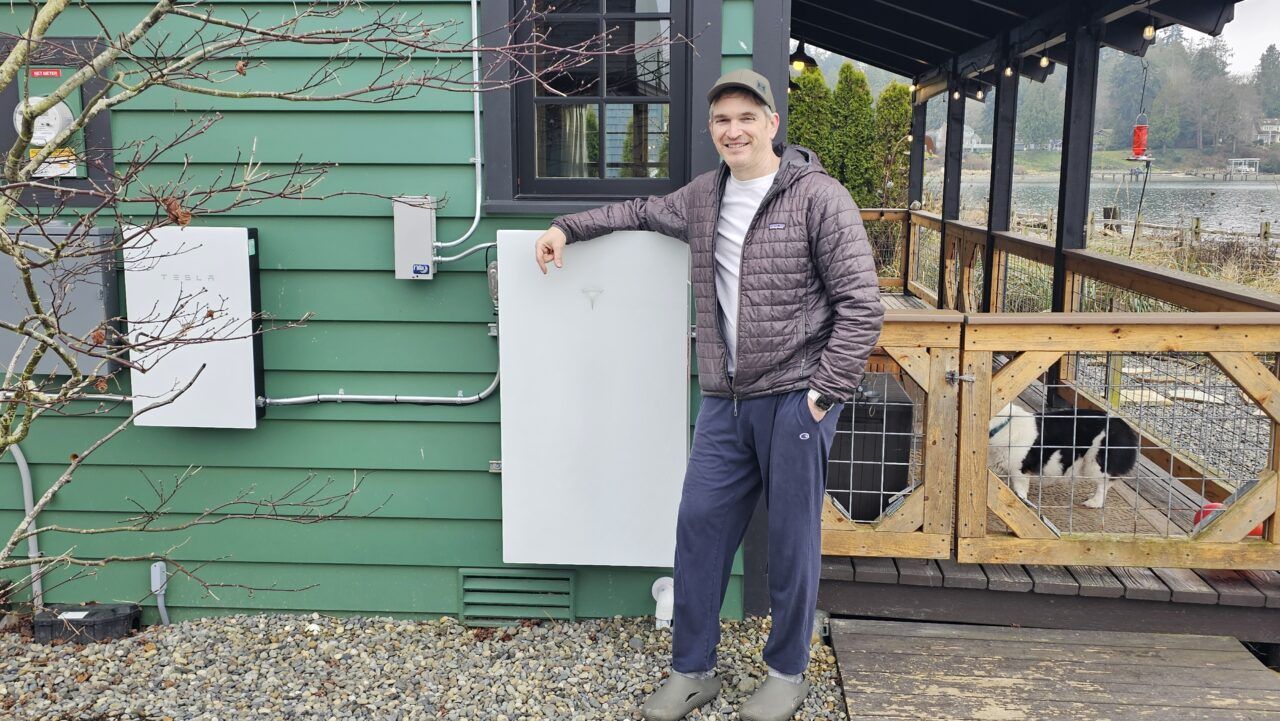
- Have a compatible battery installed and interconnected. We size it, install it, pull the permit and submit the interconnection to PSE.
- Wait for Permission to Operate. PSE approves the solar and battery system before it can run.
- Enrol at pse.com/flexbatteries. PSE processes enrolments weekly; if yours is pending for more than a week, PSE asks you to email der@pse.com.
- Send the W-9 so the enrolment check can be issued, then leave the battery to do the rest.
Already have a battery? If it is on PSE’s list and interconnected, you can enrol now; questions about an existing enrolment go to Uplight at support@pseflex.com or 1-888-793-9347.
Why homeowners choose Power Trip Energy for battery backup
- Certified installers for Tesla Powerwall 3, Enphase Energy Storage Solutions and FranklinWH, and members of PSE’s Contractor Alliance Network.
- Straight advice: until 2023 we talked most customers out of batteries because the products were not worth the money. Price and capability have changed, we have installed them with confidence since, and for PSE customers there has been an economic case as well since 2025.
- Battery experience since 2004, when Port Townsend’s first solar tracker was built as a battery-based, grid-interactive system; home storage upgrades in Port Townsend, Port Angeles and Seabeck in 2025 and 2026.
- Headquartered in Port Townsend since 2003, over 1,100 installations on the Olympic and Kitsap Peninsulas, NABCEP-certified staff, licensed Washington general contractor (POWERTE934QE) and electrical contractor (POWERTE964JN).
“We loved our decision to purchase a solar power system from Power Trip Energy. We are supporting the world’s climate health and the local business community, both important to us. Also it was a sound financial move with immediate and long term returns. The staff at Power Trip made the experience fun, easy and rewarding.”
“We could not be more pleased with our new solar array. We knew of Power Trip from friends on Marrowstone Island but became much more interested after hearing Andy speak at a neighborhood gathering. His knowledge of the industry, historical and future-facing, is comprehensive. We have enjoyed all of our interactions with Becky and Mike, who put together our bids, completed our paperwork for system approval, and conducted training on monitoring panel productivity through the app. The installation crew was enjoyable to have around the property — prompt, pleasant, efficient, neat and tidy!”
Is PSE your utility?
Flex is for Puget Sound Energy customers only. In our service area that is most of Kitsap County: Bainbridge Island, Poulsbo, Kingston, Silverdale, Bremerton and Port Orchard. In Port Townsend, Port Ludlow and the rest of Jefferson County the utility is Jefferson County PUD, and in Sequim and Port Angeles it is Clallam County PUD or the City of Port Angeles, so Flex does not apply. A battery there still keeps your lights on in an outage, and you keep net metering through your PUD.
PSE Flex questions
What is the PSE Flex program?
It is Puget Sound Energy’s demand response program. PSE pays customers to cut electricity use during short peak periods called Flex events, either by hand (Flex Rewards) or automatically through an enrolled battery, smart thermostat, EV charger or water heater.
How much does PSE Flex pay for a home battery?
$75 per kWh of storage when you enrol, up to $1,000 per battery, and $0.50 per kWh delivered during Flex events, up to $500 per battery a year. Both are paid by check.
How many Flex events are there a year?
For batteries, up to 50 per season and 100 per year, between 6 a.m. and 10 p.m., in winter (Nov 1 to Mar 31) and summer (May 1 to Sep 30), never on six major holidays. Events usually last 2 to 4 hours.
Will a Flex event leave me without backup power in an outage?
PSE never takes a battery below 20%, skips a battery already backing up a home in an outage, and says it will likely hold off on events when outage risk is high.
Which batteries qualify for PSE Flex?
Enphase, FranklinWH, SolarEdge (including LG on SolarEdge inverters) and Tesla. We are certified installers for Tesla Powerwall 3, Enphase IQ batteries and FranklinWH aPower. See home battery backup.
Can I keep net metering if I join Flex Batteries?
Yes. Energy your battery exports in an event is credited to your net metering bank like solar exports. You cannot combine Flex Batteries with PSE’s Time-of-Use rate.
Adding a battery for PSE Flex?
Tell us about your home and your solar, and we will size a battery for the loads you want backed up, quote it, and handle the permit and PSE interconnection so you can enrol. Or call the shop, Mon-Fri 8am to 5pm.