
Solar Panel Maintenance and Repair on the Olympic and Kitsap Peninsulas
A grid-tied solar array has no moving parts and needs very little looking after: the rain does most of the cleaning, and most of our customers never touch their panels. What does need attention is the rest of the system. Inverters age, a monitoring app can show a string that has stopped producing, a household’s electricity use grows, and a battery can be added to an array that was built without one. Power Trip Energy has installed over 1,100 solar systems on the Olympic and Kitsap Peninsulas since 2003. We troubleshoot and repair systems that have stopped producing, expand existing arrays, add home batteries, and give you a straight answer when something does not need doing at all.
Tell us about your system
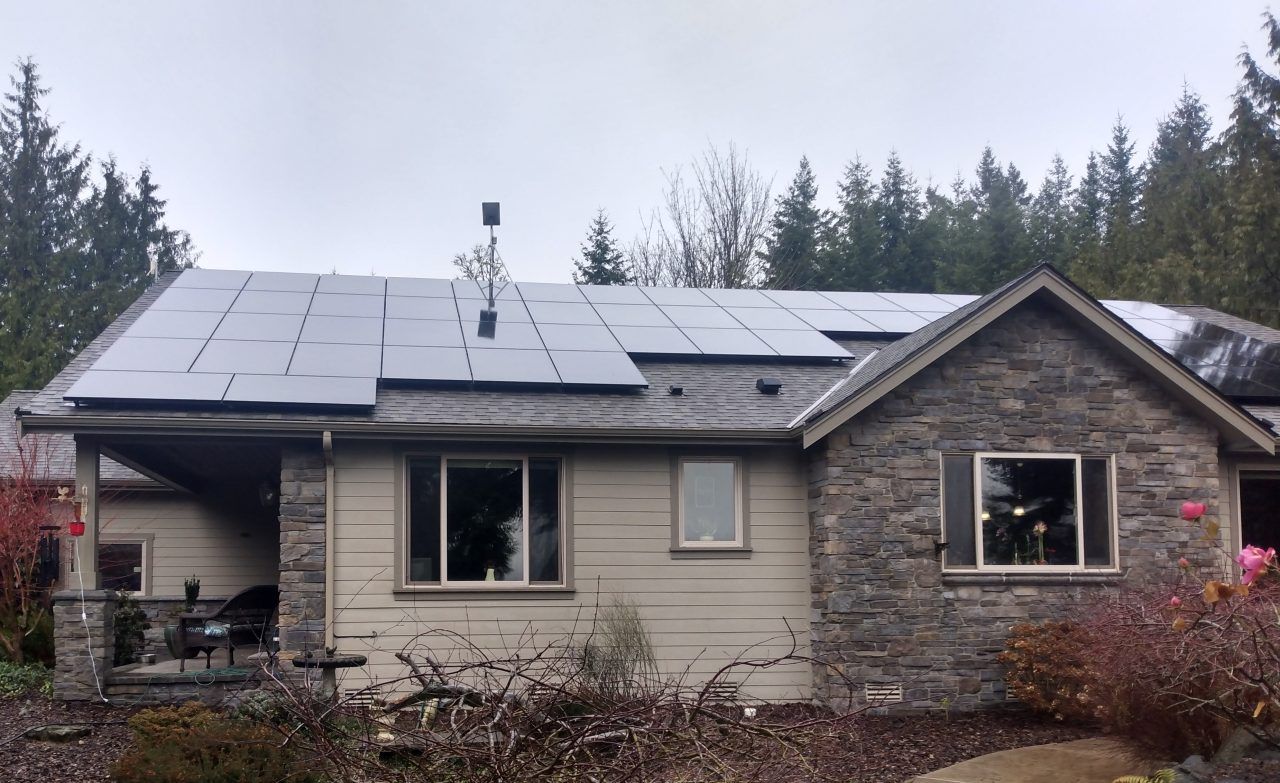
Recent upgrades to existing solar systems
What long-time customers say
“We are approaching our ten year anniversary of solar installation in October. We just passed 50,000 KW produced last week. Everything is working as expected and we are certainly thrilled with our continued solar electric production.”
“We had a sub-panel that had some issues, wasn’t really part of the install, but Power Trip provided a professional electrician to upgrade the sub-panel to code. After install service has been very good as well. Office personnel are very sharp. The net meter helps us track our solar production on a monthly basis. The system is performing to original specs.”
How we look after existing solar systems
Check your production first
Your inverter display, your monitoring app or the net meter tells you what the array is making. Compare it with the same month in earlier years: a sunny-month shortfall points to a fault, a dark December does not. We train every customer on the monitoring app at hand-over.
Call us if something looks wrong
Tell us what the display or app shows and we will troubleshoot it. On older systems the inverter is usually the part that has failed; panels rarely are. We still repair systems from our first years of business, including a 2004 array in Sequim.
Grow the system when your needs change
An electric car, a heat pump or a new workshop changes the arithmetic. We add a second phase to existing arrays as customers’ consumption grows, and we add Tesla Powerwall 3, Enphase IQ and FranklinWH batteries to arrays that were built without one.
What a grid-tied solar array actually needs
Not much, and we would rather tell you that than sell you a service plan. The tempered glass on the modules sheds rain and any dust that settles on it, and it is about as tough as a car windshield: manufacturers rate the panels to withstand one-inch hail at 90 mph. We mount modules three to four inches above the roof so leaves and branches are not trapped underneath and air can circulate to keep them cool. With a grid-tied system there is little to do beyond reading your meter or app and watching the kilowatt-hours add up. Our FAQ on maintenance.
Panel cleaning
In a particularly dirty or dusty spot it cannot hurt to rinse the modules during a dry spell, when there is no rain to do it for you. Most of our clients never bother, and on the Peninsulas the weather usually keeps up. If your array sits under trees or production has dropped and you think cleaning is the reason, ask us: we will tell you whether cleaning, a repair or nothing at all is the right answer before anyone climbs on your roof.
Inverters are the part that ages
In the early 2000s a five-year inverter warranty was the industry standard, and some inverters from that era have failed. By 2014 the standard had become 10 or 15 years. If your system is more than a decade old and has stopped producing, the inverter is the first thing we check, and we can replace a legacy unit with current equipment.
Why existing solar owners call Power Trip Energy
- Over 1,100 installations on the Olympic and Kitsap Peninsulas since 2003, so we know the equipment the region’s older arrays were built with.
- Our workmanship warranty is 10 years. When a 2004 system in Sequim stopped producing, our co-founder Steve diagnosed the failed inverter and put the system back online at no charge, warranty or not. Read that story.
- In our own words from the FAQ: if you have a problem with your system, we will be there to take care of it.
- NABCEP-certified staff, licensed Washington general contractor (POWERTE934QE) and electrical contractor (POWERTE964JN), and customers trained on their monitoring app at hand-over.
Solar maintenance questions
Do solar panels need regular maintenance?
Grid-tied solar panels have no moving parts and are nearly maintenance free. Rain keeps the glass clean, the modules are mounted clear of the roof so debris does not collect, and there is no scheduled service to book. Keep an eye on production and call us if it drops. More in our FAQ.
Should I have my solar panels cleaned?
Usually not. Most of our clients never clean their panels, because the Peninsulas’ rain does it. In a particularly dusty location it cannot hurt to rinse the modules during dry weather. If you think cleaning is why your production has fallen, ask us first; we will tell you whether it is the panels or something else.
How do I know my solar system is working properly?
Your inverter display or monitoring app shows what the array is producing, and your utility’s net meter shows what you exported. Compare a month with the same month in an earlier year. Enphase customers can follow the app tutorial we link from our blog: Enphase app tutorial.
My system has stopped producing. What should I do?
First check whether the grid is down: a grid-tied inverter shuts itself off in a blackout so it cannot back-feed the lines, and restarts when power returns. If the grid is up and the inverter shows a fault or nothing at all, call us with what it displays. On older systems a failed inverter is the usual cause. Outages in our FAQ.
Can I add more panels to my existing array?
Yes. We are always happy to help customers expand their existing arrays as their consumption changes, and many of our projects are second phases: Sequim and Bremerton in 2024, a 2 kW addition in Port Townsend in 2024, Port Angeles in 2025 and a 3.15 kW expansion in Port Ludlow in 2026. We check the roof, the inverter capacity and your utility’s interconnection paperwork before we quote.
Can I add a battery to the solar system I already have?
Yes. Our recent home storage projects in Port Townsend, Port Angeles and Seabeck were all additions to existing arrays. We are certified installers for Tesla Powerwall 3, Enphase IQ Battery and FranklinWH, and PSE customers can enrol a compatible battery in PSE Flex. Home battery backup.
How long do solar panels last?
The REC modules we install carry a 25-year warranty and are rated by the manufacturer to last 40 years. Panels built by Bell Labs in the 1950s are still working. Inverters have shorter lives, which is why they are the usual repair on a system that is more than ten years old. System life in our FAQ.
Where we service and upgrade solar systems
From our Port Townsend shop we service solar systems across the Kitsap Peninsula (PSE territory): Bainbridge Island, Poulsbo, Kingston, Silverdale, Seabeck, Bremerton and Port Orchard; across Jefferson County (Jefferson County PUD): Port Townsend, Port Hadlock, Chimacum, Port Ludlow and Quilcene; and on the North Olympic Peninsula (Clallam County PUD or the City of Port Angeles): Sequim and Port Angeles. See the whole Olympic Peninsula service area.
Need a hand with your solar system?
Call the shop, Mon-Fri 8am to 5pm, with what your inverter or app is showing and we will troubleshoot it with you. Thinking about more panels or a battery? Request a site visit and we will look at the roof, the inverter and your bills.